Pot calling Kettle:
Birds of a feather:
10/30/20253 min read
Last week, I told you about the guy who was supposed to have written “novels of humanism”, but who, in the book I discussed, exhibited the resident evil within him. I termed this phenomenon “malevolence”; many other critics found Mulk Raj Anand’s tantrums extremely childish and churlish. One of them was Saros Cowasjee, who actually advised Anand to rewrite the entire May Mainwaring saga—in his novel “Coolie”—if not get rid of it completely.
Imagine my surprise, then, when I discovered that Cowasjee did not heed his own advice. In fact, he went hammer and tongs in his attempts to vilify and even “crucify” one of the characters in his appalling book called Goodbye to Elsa. As if there were nothing else to write about, Anand only sought to expose Mrs Mainwaring’s sexual proclivities in the broadest terms; Cowasjee descends into minutest detail, to hypothesize regarding the antecedents and origins of the “Anglo-Indian”.
The lead character in the book (I hesitate to call it a “novel”) is Tristan Elliott, a snob who is much given to fractions when it comes to genetics. Since his father was British—and therefore, a pure breed—and his mother an Anglo-Indian—and therefore, a mere half-breed—Tristan is almost proud of the fact that he is three-quarters “white”. For people of a certain bent of mind, it is easy to do the math and arrive at such a conclusion. But, when Tristan re-locates to London, there to earn a degree in History, one of his student-associates lays bare the truth—as he sees it—of the equation. Rajeshwar Dayal identifies Anglo-Indians as: “traitors, blackguards, knaves and time-servers”, and goes into further detail regarding their chemistry: “But you, with two drops of British blood in you, sold us to the Imperialists.” What the character (and Cowasjee—his creator) does not realize is that blood is not the bodily fluid that goes into the making of a living thing. 15 years ago, in my book Black and White, I concluded that the reader of Cowasjee’s book will soon realize that it is nothing more than “a compilation of ravings.”
Tristan once again re-locates to Canada, there to become a teacher of History. He is quite forthcoming with regard to his views of his adopted country. He has heard that “it is a fairly civilized place”, more so because, in Canada, “there were more professors than janitors”. He knows that Canadian men prefer big-sized pleasure, just like their neighbours to the south of that country, and is not upset when other men ogle his over-sized wife. He endorses the view that Canadians have no real history, before returning to his original rant, that Anglo-Indians, being “devoid of any loyalties”, were the preferred recruits to the Indian Police, not just for “their corruption and brutality”, but because they would “take no sides in the frequent Hindu-Muslim feuds”.
It is a widely accepted idea that even the devil may quote the Scriptures. Cowasjee’s human “devil” is none other than the Anglo-Indian, the best representative being his narrator, Tristan Elliott. The man declares, in pointed, perverse and pilfered phrases: “I am Alpha and Omega, the beginning and the end, the first and the last”. Later, after he is rejected by one of his girl-friends, he “knelt down and prayed: ‘My God, my God, why hast thou forsaken me’”. This trivializing of the Christian faith is brought to the forefront with the dustjacket of the book. It has a mop-haired man with a goatee, recumbent on a massive wooden cross, arms outstretched, one leg over the other, wearing what can only be described as an over-sized shirt, or even an Indian kurta.
Here is my verdict of the book in its entirety: “All this pernicious piffle will upset the nominal Christian, to say nothing about the practising one”. This conclusion is there, in black and white, in my book bearing the same title.
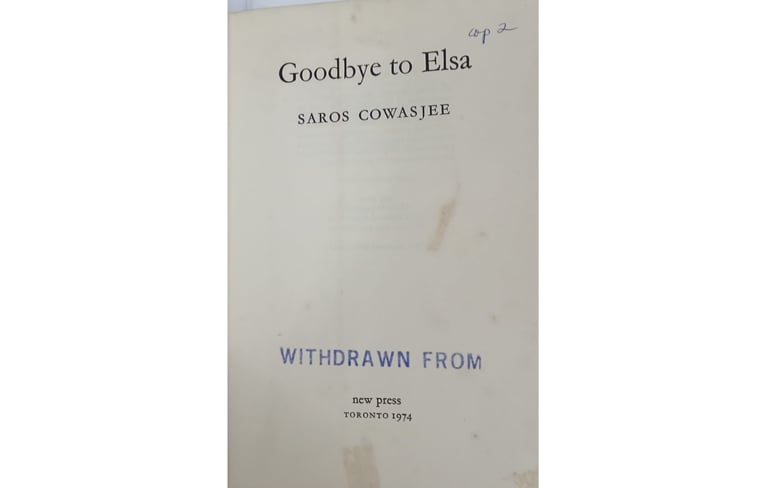
What I only just discovered, when I was re-reading the book for this blog, was that the inner Cover Page, apart from the title and the author’s name, has the words “WITHDRAWN FROM” stamped above the details of the publication given below it. I don’t know from where I picked up this copy, but I can surely say that the book deserves the dustbin, if not the incinerator.
I did not mention it earlier, but let me say it out loud, now. Most of the books dealing with fictional Anglo-Indian characters, by writers of all nationalities, lean very heavily on platitudes. This repeated flogging of a “supposedly” dead horse has gone on for far too long. It needs to stop. I made this appeal almost 15 years ago, but no one took heed. In fact, I believe that my research has been plundered and plagiarized by dubious scholars who should have known better.
One day, perhaps, the truth will out. And that is enough for me.