
Etiquette in sports
One rule only-play to win
7/3/20264 min read
The world’s biggest sporting extravaganza is slowly drawing to its climax. Who will win the 2026 edition of the Football World Cup? At this point in time it is anybody’s guess, but all of us have our favourites and we get more and more excited when our chosen team does well. But spare a thought for the also-rans. Their football programs may have cost their governments huge amounts of money, but when they come a cropper, the blame-game begins. The Gulf countries, for example, spend exorbitantly, but when the returns are meagre, someone has to be sacrificed, whether it be the coach, the manager, or, perhaps, even the designated Minister for Sports.
To identify where “football” emerged as a sport would be next to impossible. Human beings love to use their limbs, and if you can juggle a ball with only your feet, you may be well on the way to becoming a millionaire. Some of us just don’t know how to put our best foot forward, many of us are unblessed with two left feet (or the other way round, if you’re a southpaw), and the philosophical kind would argue that there are better ways to make a ball travel from point A to point B.
However, a semblance of football became popular in ancient China. In the 2nd century BCE, a military exercise resembling football emerged; it involved using the legs only, putting a ball through a narrow bamboo “goal”. From military playgrounds, the sport spread all over Han dynasty China.
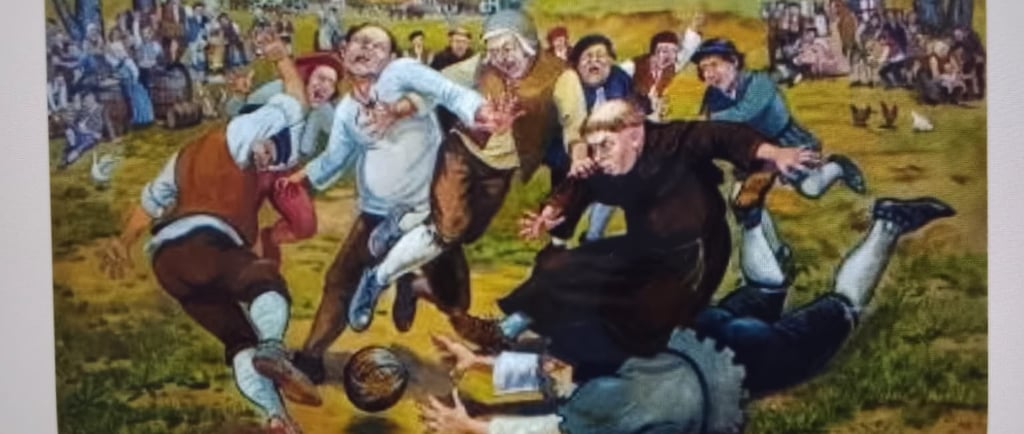
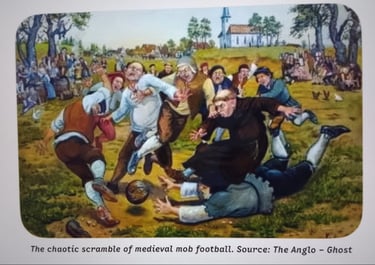
Fast forward to 18th century England, and the rudiments of modern football can be seen. The sport usually involved two sides, perhaps two neighbouring villages, and it was a free-for-all for everyone. The rough and tumble of the sport took its toll on the populace, and the need for rules became necessary. Only feet, no hands (except for the goalkeeper) became the norm. Some factions believed that it was a divine right to run across the playing area with ball in hand, and they stomped off to establish the game of rugby.
Slowly, but surely, the game spread; the Football Association was started in 1863 ( in England, of course), and soon “Assoc” football took the world by storm, as “soccer” began to be played everywhere.
Sorry, not everywhere, dear Readers. My country, the biggest in the world—population-wise—can send a spacecraft to the moon and beyond, but it has never sent a team to the football World Cup. We can explain all this by going back in time to a time when football was a full-contact sport. You could hack your opponent down from behind, you could barge into him with no intention of getting the ball, you could even gouge his eyes out if you did it unintentionally (meaning, the referee did not see it!). That is why Indians have not taken to football; after all, it’s not a “gentleman’s game”. Football may have been Britain’s gift to the sporting world, but for nearly 500 years the white man in India used the natives as footballs, and history, they say, has a way of repeating itself. We were not going to be thrashed all over again (albeit on a field), so we— and to some extent, our neighbour to the North-east—are satisfied to be spectators, sitting comfortably in front of our gigantic TVs.
To hell with what the rest of the world thinks—we have our principles. We do not cheat, we acknowledge the Almighty in various ways when we do play, and thanks to modern rules that govern most sports and sports-bodies, fair play seems to be the order of the day today.
Now for the most debated World Cup football match in history—the one involving the “hand of God”. This was the Quarter-final match between Argentina and England, played in Mexico, at the Aztec stadium, on the 22nd of June, 1986. Many pundits labelled the game as a war of attrition, for the Falklands War was still fresh in the memory. The members of both teams tried to downplay the tension, but it still remained a high-voltage clash. The first half went goalless. Six minutes into the second, Diego Maradona pulled off the impossible. A mistake by an English defender saw the ball loop towards the English goalkeeper. It was almost a David versus Goliath scene- the diminutive Maradona against the six-footer Peter Shilton. Miraculously, Maradona punched-“headed” the ball into the net. There was no VAR, there was no consultation between referee and linesman, but the whole world saw and disbelieved. The goal stood, Argentina went on to win the Cup, and at least one country felt relieved. But, not long after, Diego Maradona confessed that the all-important goal was scored “ a little with the head of Maradona and a little with the hand of God”!
It’s forty years since the incident took place. Just out of curiosity, I began thinking about the import of Maradona’s words. Were they just tongue-in-cheek, or are they supposed to deliver a stronger message? Four years had passed since the Falklands defeat, but memory is not so short-lived. The defeat of England on the football field was seen as a vindication of some sort; put into that context, wasn’t the loss some kind of divine retribution, too? Of course, I’m not just spamming.
Believe it or not, dear Readers. Truth is very often stranger than fiction.